
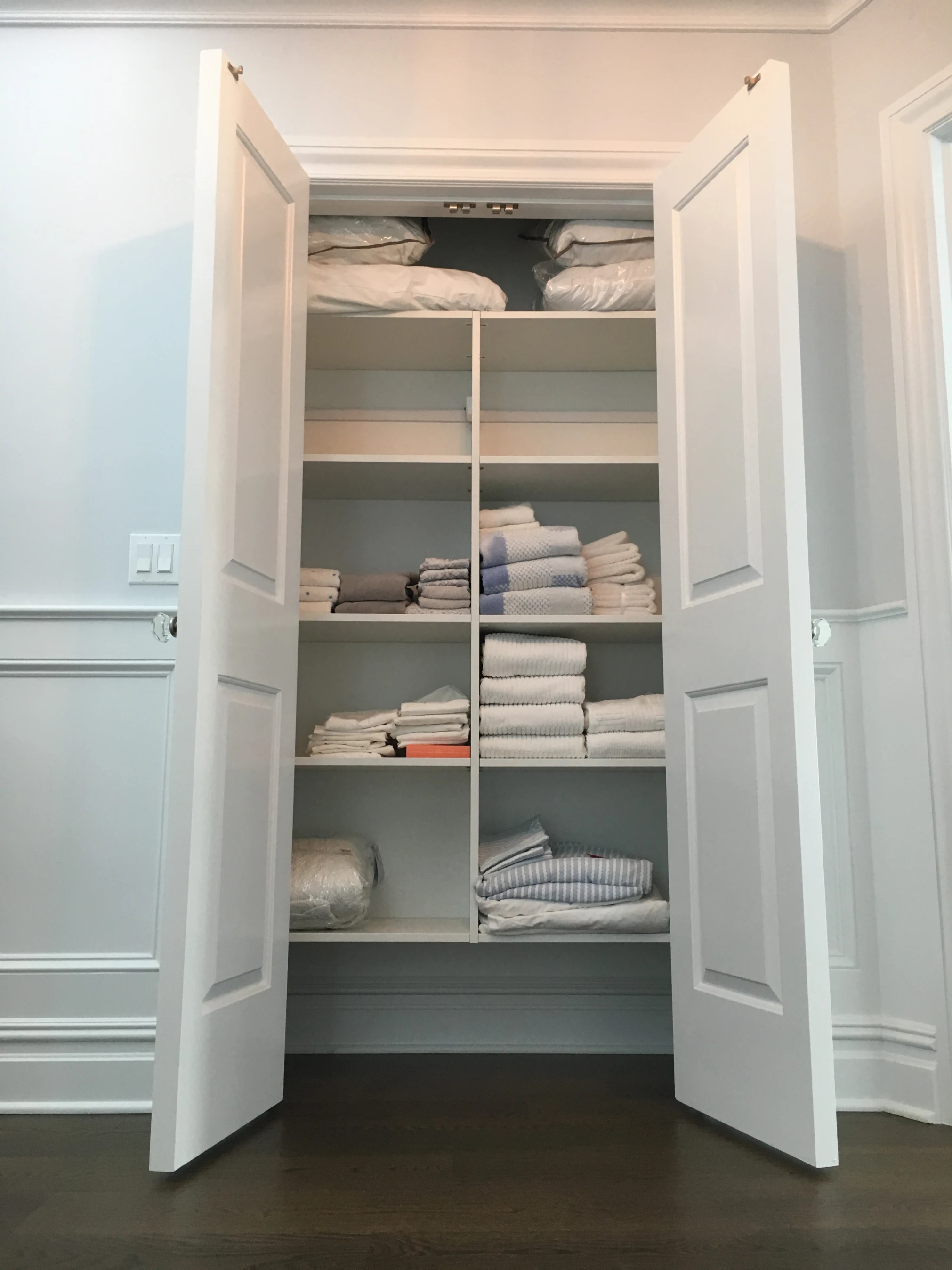
How to Create a Linen Closet Organization System That You’ll Love
Open the linen closet, and something will probably fall out. It might be a stack of towels in three different sizes that you shoved in. Or that frustrating fitted sheet that never folds flat.
Maybe you tried to clean it up by putting in some plastic containers or screwing in a shelf or two.
But the linen closet always seems to be one of the messiest spaces in any home. But it’s also one of the most fixable!
The difference between a chaotic linen closet and a functional one isn’t a larger closet per se. Instead, it may be a system built around how the space is shaped and what it needs to hold.
Why are Linen Closets So Hard to Keep Organized?
Many linen closets are built as an afterthought. Some are meant for something else but are repurposed as a linen storage space out of necessity.
Many are built with one or two fixed shelves, a single width, and no real accommodation for the variety of things that end up inside.
But a standard bedsheet set takes up a very different amount of space than a rolled beach towel. And nothing takes up more space than a king-size comforter, which sits next to a stack of guest pillows that falls every time you reach for the towels.
Linen closets are designed for soft essentials, not deep storage. Yet they still need to handle a large range of sizes and items. And if the shelving doesn’t match those realities, the closet fights you. So the right linen closet fix starts with getting the structure right.
Right-Size Your Shelves First
You’ll find that shelf depth matters more in a linen closet than in almost any other storage. If you have shelves that are too deep (typically 20 or more inches) they’ll push folded linens to the back, where they’re invisible and impossible to reach without pulling everything forward. But shelves that are too shallow leave things tipping off the edge.
Bella designers recommend approximately 12–15 inches of depth for linen closet shelves. This size is shallow enough to keep folded towels and sheets in full view, but deep enough for a standard stack.
Adjustable shelving can help in many cases, as a single fixed height can’t accommodate both a fluffy winter duvet and a slim stack of guest hand towels. Customizing shelf spacing means you can adjust heights as your needs change rather than rebuilding from scratch each time.
Zones, Categories, and Bins That Hold Their Shape
Think through your most frustrating storage space. The reality is that a linen closet without zones is just a shelf with things on it.
But when you design with zones in mind, every item has a designated address. Plus, restocking and putting things away take seconds. A common hierarchy looks like:
- The most-used items at eye level
- Bulky or seasonal items on higher and lower shelves
- Small loose items corralled in labeled bins
Organizers recommend keeping around two sets of sheets per bed — one in use and one backup — and one summer and one winter blanket per bed. That gives you a framework for what stays.
Bins and baskets earn their keep by keeping groups of items contained: one bin for queen sheets, one for guest towels, one for extra toiletries. Adjustable shelves, stackable bins, and labeled categories are the same tools Bella uses in deep closets — they work just as well in a narrow linen layout.
Rolling vs. Folding: What Type of Folding Saves the Most Space?
The answer? Both have a place. Flat folding often works best for items such as sheets and pillowcases. But the key is consistency: fold everything the same way, with the folded edge facing outward, so the stack looks uniform.
Rolling works better for thick or bulky items. Things such as bath towels, beach towels, or extra blankets often fit better when rolled.
The position you place them also helps – rolled towels stored upright in a bin are individually accessible without disturbing the rest.
The practical answer in most closets is a combination: sheets flat-folded on shelves, thick towels rolled in bins below.
Are You Using the Door?
A pro tip for organizing the linen closet? Use the inside of a linen closet door! The inside of a closet door is some of the most underused storage real estate in any home.
An over-door rack can hold more than you think. You can store cleaning supplies, extra soap, hand towels, or first-aid items that would otherwise take up half a shelf.
Door-mounted racks, labeled baskets, and soft-close pull-out drawers are accessories that Bella integrates into custom linen layouts precisely because they capture space that fixed shelving can’t reach.
Even in a small or narrow linen closet, the door adds a meaningful amount of usable space when it’s treated as part of the system.
Seasonal Bedding Rotation in Linen Closets
Just like larger closets, seasonal rotations can help keep things clean and clear.
The same seasonal rotation logic Bella applies to clothing — dedicated zones for in-season versus off-season items, adjustable shelving that accommodates varying volumes — works equally well for bedding.
Off-season comforters and duvets can be stored in vacuum bags or large zippered storage bags. Move them to a high shelf or a separate under-bed container when the season turns, and your everyday shelves stay clear.
Your Linen Closet Can Be A Calm Place
A well-organized linen closet doesn’t mean you need an overhaul. Most of the time, you just need to rethink the structure.
Bella’s custom linen closet solutions are built around your closet’s exact dimensions, so every towel and blanket has a clear place to stay. Bella offers a free design consultation and a 3D rendering within 24 hours.
Find more great closet design and storage ideas on the Bella blog.


